Psychedelic Research and Neuroscience
For centuries, humans have sought answers to fundamental questions about existence:
- What ignites our consciousness?
- How do we create our perceptions?
- Why do our thoughts feel so vivid and real?
- What influences our behaviors?
Thanks to incredible advancements in modern neuroscience, we are unlocking answers to these timeless inquiries about our nature and essence!
As we embark on this fascinating exploration of consciousness and perception, particularly through the innovative lens of psychedelic neuroscience research, we find ourselves at the forefront of a revolutionary opportunity to redefine these concepts into frameworks that foster growth and self-discovery.
At Psychedelics Solution, we are committed to enhancing access to groundbreaking research by creating educational resources that empower everyone to engage with the latest theories and findings.
Our aim is to provide practical insights that can enrich daily life.
By focusing on neuroscience, consciousness studies and cognitive sciences, we strive to illuminate the intricate connection between the human experience and brain function. Together, we can unlock a wealth of possibilities, helping us better understand ourselves and our incredible potential!
What Is Neuroscience?
Neuroscience is an incredibly exciting field that dives deep into the complexities of our brain and nervous system. It reveals how various biological factors influence our thoughts, cognitive skills and emotional reactions. In our rapidly changing world, neuroscience beautifully blends insights from biology, psychology and medical technology, helping us paint a complete picture of the human experience.
By deepening our understanding of the brain, researchers are opening doors to enhance learning and adaptability, leading to innovative breakthroughs in education, mental health and personal growth. It’s a thrilling time to explore these connections and their potential to improve lives and I can’t wait to see what the future holds!
What Is Psychedelic Research?
Psychedelic research is an exciting and impactful journey into the incredible effects that psychedelics can have on our human experience. This field plays a key role in deepening our understanding, both scientifically and educationally.
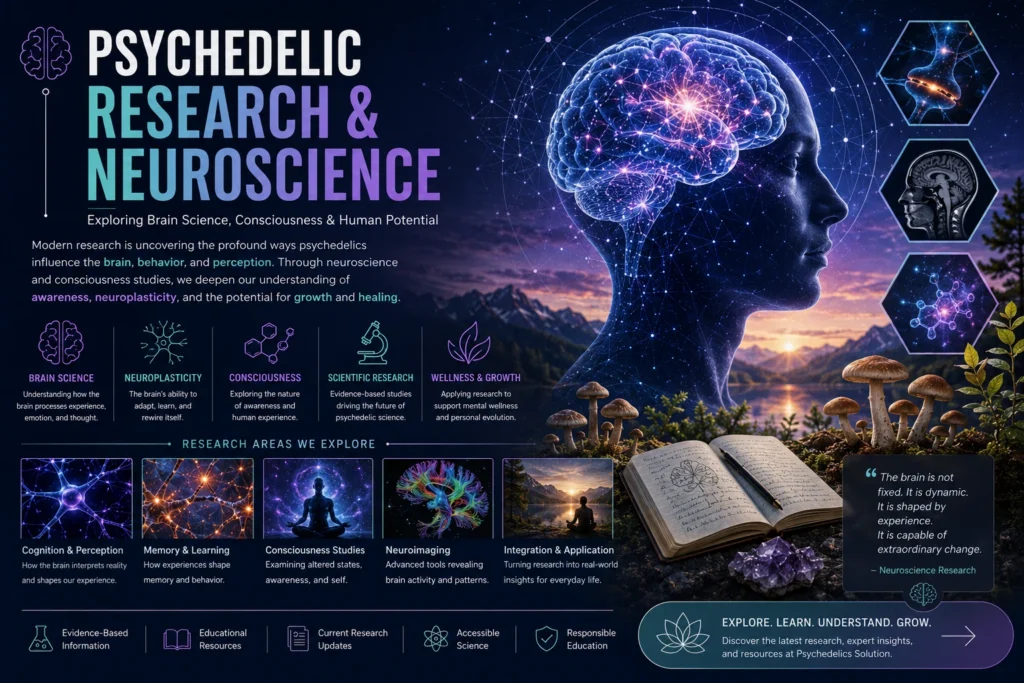
The areas commonly examined include:
- The nature of consciousness.
- The intricacies of perception.
- The mechanisms of cognition.
- The potential for neuroplasticity.
- Behavioral patterns.
- The range of human emotions.
- The processes of learning.
- Innovative research methodologies
As we expand our knowledge, this vibrant research area continues to grow with the help of cutting-edge technology and revolutionary methods. Embracing psychedelic research opens up amazing opportunities for transformative insights and advancements in mental health, education, and much more.
The Growing Relationship Between Neuroscience and Consciousness
The journey to uncover how our brains create the rich tapestry of conscious experience is nothing short of thrilling. It is a fascinating mystery that inspires scientists every day and it holds the promise of deepening our understanding of what makes us truly human.
Researchers are looking into captivating areas like:
- Attention systems.
- Memory networks.
- Emotional processing.
- Sensory interpretation.
- Self-awareness.
- Learning mechanisms
While we have made significant progress, many vital questions remain unanswered. The pursuit of knowledge in this field is not just a scientific endeavor; it is key to unlocking the secrets of our conscious experience and the essence of who we are. We must continue this journey to uncover the profound complexities of the mind.
Neuroplasticity: The Brain’s Ability to Adapt
Neuroplasticity is a groundbreaking concept in neuroscience that highlights the brain’s remarkable ability to change and adapt through learning and experiences.
Understanding neuroplasticity is crucial in various academic fields as it illuminates:
- How habits are formed and reinforced.
- The ways in which we learn and retain knowledge.
- Strategies for modifying behaviors,
- The flexibility that allows us to shift our thinking, and
- The pathways through which we develop skills.
This powerful idea has revolutionized our approach to education, making it clear that personal and lifelong growth is not only possible but also within reach for everyone.
Five Core Areas of Modern Brain Research
1. Cognition
How humans think, process information, and make decisions.
Questions explored:
- How does attention work?
- How are decisions formed?
2. Consciousness
The experience of awareness.
Questions explored:
- What creates perception?
- How does awareness emerge?
3. Memory
How information is stored and recalled.
Questions explored:
- Why are some experiences remembered?
- How does learning change memory?
4. Emotion
How emotional processing influences behavior.
Questions explored:
- How are emotional responses formed?
- What influences emotional regulation?
5. Learning
How people adapt and acquire new skills.
Questions explored:
- What improves learning?
- How does repetition influence behavior?
Brain Science Meets Everyday Life
Neuroscience is not only theoretical.
Brain science influences:
Learning habits
Attention
Reflection
Stress management
Decision making
Personal growth
Productivity
Daily routines
Simple practices often connected with awareness include:
- Journaling
- Mindfulness
- Reflection
- Habit tracking
- Intentional learning
A Beginner’s Neuroscience Learning Framework
Learn
Observe
Reflect
Apply
Repeat.
Research Literacy: How to Think More Critically
When reading scientific content:
Ask:
- What was studied?
- How large was the sample?
- What conclusions are supported?
- What remains uncertain?
Good science encourages questions.
Understanding develops gradually.
The Future of Research & Human Understanding
Scientific progress continues to reshape how we understand:
- Consciousness
- Learning
- Behavior
- Awareness
- Human potential
The most exciting discoveries often begin with better questions.
Education allows curiosity to become understanding.
Frequently Asked Questions
What is neuroscience?
Neuroscience is the scientific study of the brain and nervous system.
What is psychedelic research?
A scientific and educational field exploring perception, cognition, and consciousness.
What is neuroplasticity?
The brain’s ability to adapt and change through experience and learning.
Why study consciousness?
Understanding awareness helps expand knowledge about behavior and human experience.
Is neuroscience useful in daily life?
Brain science influences habits, learning, attention, and personal development.
Explore the Science of Human Experience
Research begins with curiosity.
Neuroscience begins with observation.
Understanding grows through education.
Explore educational resources, research discussions, and scientific insights designed to make complex ideas more accessible—and discover how studying the brain may change the way we understand ourselves.
Latest Blogs
← Complete Ketamine Powder Guide Ketamine for Depression: Effectiveness, Treatment, Risks & What Research Shows How ketamine and esketamine are…
Read More+← Miami Ketamine Therapy Guide How Does Ketamine Therapy Work in Miami, Florida? The science behind ketamine, how a treatment…
Read More+← Miami Ketamine Therapy Guide Ketamine Therapy Safety & Side Effects in Miami, Florida Common and serious side effects, monitoring,…
Read More+← Miami Ketamine Therapy Guide Ketamine-Assisted Psychotherapy in Miami, Florida A complete guide to how KAP works, potential benefits, safety,…
Read More+← Miami Ketamine Therapy Guide Ketamine Therapy for Anxiety in Miami, Florida Treatment, research, safety, and what to know before…
Read More+← Miami Ketamine Therapy Guide Ketamine Therapy for PTSD in Miami, Florida Treatment, research, safety, and what to know before…
Read More+