Ketamine for Depression: Effectiveness, Treatment, Risks & What Research Shows
How ketamine and esketamine are used for depression especially treatment-resistant depression including effectiveness, speed of onset, risks, and current evidence.
Educational information — not medical advice. Last reviewed: [September 2026].
Ketamine has become one of the most closely studied rapid-acting treatments for severe and treatment-resistant depression.
Unlike traditional antidepressants, which often take several weeks to produce their full effects, ketamine can produce antidepressant effects much more rapidly in some patients. NIMH-supported research has found that ketamine can reduce depressive symptoms within hours in some people with treatment-resistant depression.
However, an important distinction is necessary: ketamine itself is not FDA-approved in the United States as a treatment for depression. A related medication called esketamine is FDA-approved for specific depression indications, including treatment-resistant depression. Esketamine is administered as a nasal spray in a certified healthcare setting.
Ketamine may nevertheless be used off-label by clinicians for depression when they determine that it is medically appropriate.
This article explains the difference between ketamine and esketamine, what the evidence shows, who may benefit, potential risks, and the questions patients commonly ask. It’s part of our complete ketamine powder guide.
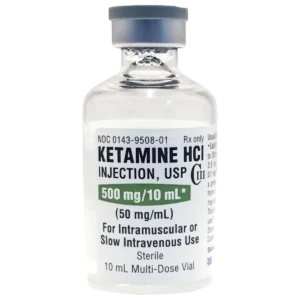
 Ketamine Liquid 500mg/10ml $500.00 – $5,500.00Price range: $500.00 through $5,500.00
- Ketamine Powder 250mg $600.00 – $25,000.00Price range: $600.00 through $25,000.00
If You Need Help Right Now
If you or someone you know is in crisis or having thoughts of suicide, help is available 24/7:
- Call or text 988 — the 988 Suicide & Crisis Lifeline (US), available 24/7
- Text HOME to 741741 — Crisis Text Line
- Call 911 or go to the nearest emergency room for immediate danger
- Ketamine Liquid 500mg/10ml $500.00 – $5,500.00Price range: $500.00 through $5,500.00
- Ketamine Powder 250mg $600.00 – $25,000.00Price range: $600.00 through $25,000.00
Key Takeaways
- Ketamine has demonstrated rapid antidepressant effects in clinical research
- It has been studied extensively in people with treatment-resistant depression (TRD)
- Ketamine itself is not FDA-approved for depression in the United States
- Esketamine nasal spray is FDA-approved for specific depression indications
- Ketamine works differently from conventional antidepressants, with important effects involving glutamate and NMDA receptor signaling
- Not everyone with depression responds to ketamine or esketamine
- Benefits may not be permanent, and some patients require ongoing treatment or maintenance strategies
- Ketamine can cause side effects and has potential risks involving blood pressure, dissociation, sedation, misuse, and dependence
- Ketamine treatment should be provided within an appropriate medical framework rather than through unsupervised self-treatment
- Ketamine Liquid 500mg/10ml $500.00 – $5,500.00Price range: $500.00 through $5,500.00
- Ketamine Powder 250mg $600.00 – $25,000.00Price range: $600.00 through $25,000.00
Guide Contents
Table of Contents
About This Resource: Psychedelics Solution
This guide is published by Psychedelics Solution as an educational resource, independent of any specific treatment page. Psychedelics Solution is based at 325 Whispering Pines Circle, Dallas, TX 75240.
Phone: +1 (854) 289-9996
- Ketamine Liquid 500mg/10ml $500.00 – $5,500.00Price range: $500.00 through $5,500.00
- Ketamine Powder 250mg $600.00 – $25,000.00Price range: $600.00 through $25,000.00
What Is Treatment-Resistant Depression?
Treatment-resistant depression, often abbreviated TRD, generally refers to depression that has not improved adequately despite appropriate treatment attempts. NIMH describes treatment-resistant depression as depression that does not improve after trying at least two antidepressants.
Treatment resistance can be complicated. A person may have persistent symptoms because:
- The medication was ineffective
- The dose or treatment duration was inadequate
- Side effects prevented continued treatment
- The diagnosis needs reassessment
- Another medical condition is contributing to symptoms
- Another psychiatric condition is present
- Treatment adherence has been difficult
- Psychotherapy or other treatments have not been adequately incorporated
Consequently, “treatment-resistant” does not simply mean that someone tried one antidepressant and it did not work. A qualified clinician should determine whether someone actually meets criteria for treatment-resistant depression.
- Ketamine Liquid 500mg/10ml $500.00 – $5,500.00Price range: $500.00 through $5,500.00
- Ketamine Powder 250mg $600.00 – $25,000.00Price range: $600.00 through $25,000.00
Why Is Ketamine Being Studied for Depression?
Traditional antidepressants commonly influence monoamine neurotransmitters such as serotonin, norepinephrine, and dopamine. Ketamine works through a substantially different pathway: one of its major pharmacological actions involves NMDA receptor antagonism, affecting the brain’s glutamate signaling system — see How Does Ketamine Work?
Research suggests that downstream effects may influence:
- Synaptic plasticity
- Neural connectivity
- Glutamate signaling
- Brain circuits involved in mood
- Learning and emotional processing
NIMH research has helped investigate how ketamine can rapidly influence neural connections and antidepressant responses. The exact biological explanation is more complicated than simply saying that ketamine “increases glutamate.” Researchers continue to investigate the molecular and cellular mechanisms responsible for its antidepressant effects.
- Ketamine Liquid 500mg/10ml $500.00 – $5,500.00Price range: $500.00 through $5,500.00
- Ketamine Powder 250mg $600.00 – $25,000.00Price range: $600.00 through $25,000.00
How Quickly Does Ketamine Work for Depression?
One of ketamine’s most notable characteristics is its potentially rapid antidepressant effect. Some patients experience meaningful reductions in depressive symptoms within hours rather than waiting several weeks. NIMH describes ketamine as capable of lifting depression in many patients within hours, particularly in treatment-resistant depression research.
This does not mean everyone experiences immediate improvement. Response varies according to:
- Diagnosis
- Severity of depression
- Previous treatments
- Individual biology
- Treatment formulation
- Clinical protocol
- Other psychiatric or medical conditions
Rapid onset is one of the reasons ketamine has attracted so much attention in psychiatric research.
- Ketamine Liquid 500mg/10ml $500.00 – $5,500.00Price range: $500.00 through $5,500.00
- Ketamine Powder 250mg $600.00 – $25,000.00Price range: $600.00 through $25,000.00
How Effective Is Ketamine for Depression?
Research supports ketamine as an effective rapid-acting antidepressant for some people with treatment-resistant depression. However, it is not universally effective.
A 2025 systematic review of clinical and demographic predictors reported that although accumulating evidence supports ketamine and esketamine for treatment-resistant depression, a substantial proportion of patients do not respond.
This is an important point for patients researching ketamine treatment: ketamine is not a guaranteed cure for depression. Some people experience substantial improvement. Others experience partial improvement. Some do not respond adequately. Researchers are therefore increasingly interested in identifying which characteristics predict response.
- Ketamine Liquid 500mg/10ml $500.00 – $5,500.00Price range: $500.00 through $5,500.00
- Ketamine Powder 250mg $600.00 – $25,000.00Price range: $600.00 through $25,000.00
Ketamine vs. Traditional Antidepressants
Ketamine differs from conventional antidepressants in several important ways.
| Feature | Traditional Antidepressants | Ketamine-Based Treatment |
|---|---|---|
| Typical mechanism | Often serotonin, norepinephrine, dopamine systems | Primarily involves glutamate/NMDA signaling |
| Onset | Often weeks | Can be much faster in responders |
| Main evidence | Broad depression population | Particularly studied in treatment-resistant depression |
| FDA status | Many approved for depression | Ketamine itself is not FDA-approved for depression |
| Esketamine | Not applicable | FDA-approved for specific indications |
| Monitoring | Depends on medication | Clinical supervision is important |
| Long-term strategy | Often maintenance treatment | Maintenance may be needed in some patients |
This table is a general educational comparison. Individual treatment decisions should be made with a healthcare professional. See also: Ketamine vs. Traditional Antidepressants.
- Ketamine Liquid 500mg/10ml $500.00 – $5,500.00Price range: $500.00 through $5,500.00
- Ketamine Powder 250mg $600.00 – $25,000.00Price range: $600.00 through $25,000.00
What Is Esketamine?
Esketamine is a medication closely related to ketamine. Ketamine contains two mirror-image molecules: R-ketamine and S-ketamine. Esketamine is the S-enantiomer.
The FDA approved intranasal esketamine for specific depression-related indications, including treatment-resistant depression in adults. NIMH notes that esketamine is administered in a healthcare setting and generally used alongside an oral antidepressant.
Therefore: ketamine ≠ esketamine. They are pharmacologically related, but their regulatory status, formulations, and clinical use are not identical. See our full comparison: Ketamine vs. Esketamine.
- Ketamine Liquid 500mg/10ml $500.00 – $5,500.00Price range: $500.00 through $5,500.00
- Ketamine Powder 250mg $600.00 – $25,000.00Price range: $600.00 through $25,000.00
Is Ketamine FDA Approved for Depression?
In the United States, ketamine itself is not FDA-approved as a treatment for depression. Ketamine hydrochloride injection has established FDA-approved uses as an anesthetic. Its use for depression is generally considered an off-label medical use when prescribed by a clinician.
Esketamine is different because it has FDA-approved indications for specific depression-related conditions. This distinction should be preserved whenever discussing “FDA-approved ketamine treatment.”
What Is Off-Label Ketamine Treatment?
Off-label prescribing occurs when a clinician uses an approved medication in a way that differs from the specific FDA-approved labeling. Off-label does not automatically mean illegal, experimental, unsafe, or ineffective — it means the particular use is outside the approved labeling.
Ketamine’s psychiatric use is an important example because substantial research has investigated its antidepressant effects even though ketamine itself does not have an FDA psychiatric indication.
- Ketamine Liquid 500mg/10ml $500.00 – $5,500.00Price range: $500.00 through $5,500.00
- Ketamine Powder 250mg $600.00 – $25,000.00Price range: $600.00 through $25,000.00
How Does Ketamine Affect the Brain?
Ketamine is primarily known for blocking NMDA receptors, which are involved in glutamate signaling. The downstream effects may influence synaptic plasticity and communication between neurons. One proposed model is:
Ketamine → NMDA receptor modulation → changes in glutamate signaling → downstream synaptic effects → changes in neural connectivity and plasticity
Researchers believe these effects may help explain why ketamine can produce relatively rapid changes in depressive symptoms. However, the precise antidepressant mechanism remains an active area of research. For a deeper explanation, see How Does Ketamine Work?
- Ketamine Liquid 500mg/10ml $500.00 – $5,500.00Price range: $500.00 through $5,500.00
- Ketamine Powder 250mg $600.00 – $25,000.00Price range: $600.00 through $25,000.00
Ketamine and Neuroplasticity
Neuroplasticity refers to the brain’s ability to change its structure and function in response to experiences and signals. Research has suggested that ketamine can produce changes associated with synaptic plasticity. NIMH-supported research has investigated how ketamine may stimulate the formation or strengthening of connections between brain cells.
This has led researchers to investigate whether the period following ketamine treatment could represent an opportunity for therapeutic learning and behavioral change — one reason researchers are studying combinations of ketamine and psychotherapy.
- Ketamine Liquid 500mg/10ml $500.00 – $5,500.00Price range: $500.00 through $5,500.00
- Ketamine Powder 250mg $600.00 – $25,000.00Price range: $600.00 through $25,000.00
Ketamine and Suicidal Thoughts
Ketamine has attracted significant interest because of its rapid effects on severe depressive symptoms. This is especially relevant when depression is accompanied by suicidal thinking.
However, ketamine should never be considered a substitute for emergency psychiatric care. Someone who is in immediate danger or believes they may act on suicidal thoughts needs urgent professional assistance.
Esketamine has an FDA-approved indication involving depressive symptoms associated with major depressive disorder and acute suicidal ideation or behavior, used with an oral antidepressant.
The treatment of suicidal risk remains broader than treating depressive symptoms alone. Emergency evaluation, safety planning, psychiatric treatment, social support, and other interventions may all be necessary.
- Call or text 988 — the 988 Suicide & Crisis Lifeline (US), available 24/7
- Text HOME to 741741 — Crisis Text Line
- Call 911 or go to the nearest emergency room for immediate danger
- Ketamine Liquid 500mg/10ml $500.00 – $5,500.00Price range: $500.00 through $5,500.00
- Ketamine Powder 250mg $600.00 – $25,000.00Price range: $600.00 through $25,000.00
How Long Do Ketamine's Antidepressant Effects Last?
Ketamine can act rapidly, but its antidepressant effects may not last indefinitely. This is one of the major challenges in ketamine research. Some patients experience sustained improvement; others experience a return of symptoms after the initial response.
Researchers are therefore investigating maintenance strategies. A 2026 systematic review of ketamine maintenance treatment for treatment-resistant depression noted that although acute antidepressant effects are well documented, the optimal long-term maintenance strategy remains less established.
This means that a successful initial response does not necessarily mean depression has been permanently resolved.
Does Ketamine Require Repeated Treatment?
Potentially, yes. Research suggests that some patients require more than one treatment to maintain antidepressant benefits. NIMH notes that although ketamine can work quickly, lasting effects may require more than a single treatment session.
The appropriate treatment schedule depends on the medication, clinical indication, patient response, side effects, medical history, and treatment protocol. There is no universally appropriate schedule for everyone, and treatment frequency should not be determined from online instructions.
- Ketamine Liquid 500mg/10ml $500.00 – $5,500.00Price range: $500.00 through $5,500.00
- Ketamine Powder 250mg $600.00 – $25,000.00Price range: $600.00 through $25,000.00
What Are the Side Effects of Ketamine for Depression?
Ketamine can cause side effects even when used under medical supervision. Potential short-term effects include:
- Dissociation
- Drowsiness
- Dizziness
- Nausea
- Changes in perception
- Increased blood pressure
- Increased heart rate
- Confusion
- Anxiety
- Impaired coordination
Some effects occur during or shortly after treatment and are one reason medical monitoring is important. For a comprehensive discussion, see Ketamine Side Effects.
- Ketamine Liquid 500mg/10ml $500.00 – $5,500.00Price range: $500.00 through $5,500.00
- Ketamine Powder 250mg $600.00 – $25,000.00Price range: $600.00 through $25,000.00
What Are the Long-Term Risks?
Long-term or repeated ketamine exposure raises additional concerns. Potential problems associated with repeated or heavy exposure include:
- Dependence
- Problematic use
- Tolerance
- Urinary and bladder complications
- Cognitive concerns
- Liver-related complications
- Mental-health effects
These risks need to be considered separately from the benefits observed in controlled clinical research. For more information, see Long-Term Ketamine Risks, Ketamine Bladder Risks, and Ketamine Dependence & Addiction.
Can Someone Become Addicted to Ketamine?
Yes. Ketamine can produce tolerance, dependence, cravings, and problematic use. This is particularly important when discussing long-term treatment.
A 2026 systematic review examining ketamine misuse treatment found that the evidence base for treating ketamine use disorder remains limited, emphasizing the importance of careful clinical management and further research.
Medical use and uncontrolled use should not be treated as equivalent. Nevertheless, the possibility of misuse means clinicians should consider a patient’s history and monitor for signs of problematic use.
- Ketamine Liquid 500mg/10ml $500.00 – $5,500.00Price range: $500.00 through $5,500.00
- Ketamine Powder 250mg $600.00 – $25,000.00Price range: $600.00 through $25,000.00
Ketamine-Assisted Psychotherapy for Depression
Ketamine-assisted psychotherapy, or KAP, combines ketamine treatment with structured psychological support. The underlying idea is that changes in mood, perception, and cognitive flexibility could potentially create an opportunity for therapeutic work. A typical conceptual model includes:
- Assessment
- Preparation
- Supervised treatment
- Psychotherapy
- Integration
- Follow-up
Research remains active. A 2026 systematic review found that KAP was associated with reductions in depressive symptoms across the included studies, but substantial methodological differences and limited controlled evidence prevented firm conclusions about its added benefit over control conditions.
Therefore, KAP is promising but should not be presented as a conclusively proven superior form of depression treatment.
- Ketamine Liquid 500mg/10ml $500.00 – $5,500.00Price range: $500.00 through $5,500.00
- Ketamine Powder 250mg $600.00 – $25,000.00Price range: $600.00 through $25,000.00
Can Ketamine Improve Quality of Life?
Depression affects more than mood. It can interfere with work, relationships, family life, motivation, sleep, social functioning, and daily activities.
Researchers are therefore increasingly studying whether ketamine and esketamine improve functional outcomes rather than simply reducing depression scores. A 2026 systematic review found evidence that esketamine can improve certain functional outcomes, including workplace productivity and psychosocial functioning, in people with major depressive disorder or treatment-resistant depression.
This is an important shift in depression research: successful treatment is not only about reducing symptoms; it is also about helping people function better in everyday life.
- Ketamine Liquid 500mg/10ml $500.00 – $5,500.00Price range: $500.00 through $5,500.00
- Ketamine Powder 250mg $600.00 – $25,000.00Price range: $600.00 through $25,000.00
Who Might Be Considered?
Eligibility depends on the treatment, diagnosis, medical history, and regulatory framework. A clinician may consider:
- Severity of depression
- Previous antidepressant treatments
- Response to psychotherapy
- Suicidal thoughts or behavior
- Cardiovascular health
- Blood pressure
- Liver health
- Medication interactions
- Substance-use history
- Previous ketamine exposure
- Other psychiatric conditions
For treatment-resistant depression, clinicians generally first establish that adequate conventional treatments have been attempted.
Who May Not Be a Good Candidate?
Ketamine may be inappropriate or require special consideration for some people. Potential concerns include:
- Certain cardiovascular conditions
- Uncontrolled hypertension
- Significant liver problems
- Certain psychiatric conditions
- Medication interactions
- Pregnancy or breastfeeding
- History of problematic substance use
- Previous serious reaction to ketamine
This does not mean that any single condition automatically excludes someone. The decision should be individualized by a qualified healthcare professional.
Can Ketamine Be Used With Antidepressants?
Potential interactions depend on the medications involved. In some established treatment approaches, esketamine is used alongside an oral antidepressant. However, people should not assume that every antidepressant or psychiatric medication can automatically be combined with ketamine. A clinician should review prescription medications, over-the-counter medications, supplements, alcohol use, recreational substances, and other sedating medications.
For a broader discussion, see Ketamine Drug Interactions.
Can Alcohol Be Combined With Ketamine Treatment?
Alcohol can increase the risks associated with ketamine, particularly sedation and impairment. Combining ketamine with alcohol or other central nervous system depressants can create potentially dangerous effects. Anyone receiving ketamine treatment should follow their healthcare provider’s instructions regarding alcohol and other substances. See Ketamine and Alcohol.
- Ketamine Liquid 500mg/10ml $500.00 – $5,500.00Price range: $500.00 through $5,500.00
- Ketamine Powder 250mg $600.00 – $25,000.00Price range: $600.00 through $25,000.00
Is Ketamine Better Than Antidepressants?
There is no universal answer. Ketamine and traditional antidepressants work differently and have different evidence bases, risks, regulatory statuses, and treatment strategies.
For some people with treatment-resistant depression, ketamine or esketamine may provide an option when conventional treatments have not worked adequately. For others, conventional antidepressants, psychotherapy, brain-stimulation treatments, or other approaches may be more appropriate.
The goal is not necessarily to find the “strongest” antidepressant. The goal is to identify the most appropriate evidence-based treatment for the individual.
- Ketamine Liquid 500mg/10ml $500.00 – $5,500.00Price range: $500.00 through $5,500.00
- Ketamine Powder 250mg $600.00 – $25,000.00Price range: $600.00 through $25,000.00
Ketamine vs. Electroconvulsive Therapy
Electroconvulsive therapy (ECT) remains an established treatment option for severe and treatment-resistant depression. Ketamine and ECT differ substantially: ECT involves controlled electrical stimulation of the brain under anesthesia, while ketamine acts pharmacologically, particularly through glutamatergic and NMDA-related mechanisms.
Researchers have also investigated whether ketamine-based anesthesia can influence outcomes during ECT. A 2025 systematic review and meta-analysis examined ketamine-containing ECT anesthesia regimens in treatment-resistant depression.
These treatments should not be viewed as interchangeable. A psychiatrist can help determine which approach is appropriate for a particular patient.
- Ketamine Liquid 500mg/10ml $500.00 – $5,500.00Price range: $500.00 through $5,500.00
- Ketamine Powder 250mg $600.00 – $25,000.00Price range: $600.00 through $25,000.00
Why Doesn't Ketamine Work for Everyone?
Depression is biologically and psychologically heterogeneous. Two people can have the same diagnostic label while having very different underlying contributors. Potential factors influencing response may include:
- Depression subtype
- Severity
- Previous treatment history
- Age
- Comorbid conditions
- Medication history
- Biological differences
- Genetic factors
- Substance-use history
Researchers are actively searching for reliable predictors of response. A 2026 systematic review specifically examined clinical and demographic predictors of response to ketamine and esketamine in treatment-resistant unipolar and bipolar depression. The long-term goal is more personalized treatment rather than giving the same therapy to every patient.
- Ketamine Liquid 500mg/10ml $500.00 – $5,500.00Price range: $500.00 through $5,500.00
- Ketamine Powder 250mg $600.00 – $25,000.00Price range: $600.00 through $25,000.00
Is Ketamine a Cure for Depression?
No. Ketamine should not be described as a permanent cure for depression. It may produce substantial symptom improvement in some patients, sometimes rapidly, but depression can recur. Long-term management may require a broader treatment plan involving:
- Medication
- Psychotherapy
- Lifestyle interventions
- Social support
- Treatment of coexisting conditions
- Maintenance treatment when appropriate
- Ongoing psychiatric follow-up
The objective is sustained recovery and improved functioning, not simply a temporary change in symptoms.
- Ketamine Liquid 500mg/10ml $500.00 – $5,500.00Price range: $500.00 through $5,500.00
- Ketamine Powder 250mg $600.00 – $25,000.00Price range: $600.00 through $25,000.00
What Should Someone Ask Before Considering Ketamine Treatment?
A patient considering ketamine-based treatment may want to ask:
About Diagnosis
- Do I have treatment-resistant depression?
- Have appropriate first-line treatments been tried?
- Could another condition be contributing to my symptoms?
About the Medication
- Are you recommending ketamine or esketamine?
- Is the proposed treatment FDA-approved for my condition?
- If it is off-label, what evidence supports it?
About Safety
- What medical conditions could increase my risk?
- What medications or supplements could interact with treatment?
- How will I be monitored?
About Effectiveness
- What benefits are realistic?
- How quickly might symptoms change?
- How will response be measured?
About Long-Term Treatment
- What happens if symptoms return?
- Is maintenance treatment necessary?
- What alternatives are available?
These questions can help patients make informed decisions rather than relying on marketing claims.
- Ketamine Liquid 500mg/10ml $500.00 – $5,500.00Price range: $500.00 through $5,500.00
- Ketamine Powder 250mg $600.00 – $25,000.00Price range: $600.00 through $25,000.00
Frequently Asked Questions About Ketamine for Depression
Does ketamine really work for depression?
Research indicates that ketamine can produce rapid antidepressant effects in some people, particularly those with treatment-resistant depression. However, not everyone responds, and benefits may not be permanent.
How fast does ketamine work for depression?
Some people experience improvement within hours. This rapid onset is one of the major reasons ketamine has become an important area of depression research.
Is ketamine FDA approved for depression?
Ketamine itself is not FDA-approved for depression in the United States. Esketamine is FDA-approved for specific depression indications, including treatment-resistant depression.
What is the difference between ketamine and esketamine?
Ketamine contains both R- and S-ketamine. Esketamine is the S-enantiomer. They are related medications but have different formulations and regulatory statuses.
Is ketamine used for treatment-resistant depression?
Yes. Ketamine has been extensively studied for treatment-resistant depression, and esketamine is FDA-approved for this indication in adults.
Can ketamine help severe depression?
Research suggests that ketamine can rapidly reduce depressive symptoms in some people with severe or treatment-resistant depression. However, individual responses vary.
Can ketamine stop suicidal thoughts?
Ketamine-based treatments have been investigated for rapidly reducing depressive symptoms associated with suicidal thinking. However, anyone experiencing an immediate suicide risk needs urgent professional or emergency assistance rather than attempting to self-treat.
How long does ketamine help depression?
The duration varies considerably. Some people experience sustained improvement, while others experience a return of symptoms and may require additional treatment.
Does ketamine permanently cure depression?
No. Ketamine can produce significant symptom improvement in some people but should not be considered a permanent cure.
Can you become addicted to ketamine?
Yes. Ketamine can produce tolerance, dependence, cravings, and problematic use, particularly with repeated or uncontrolled exposure.
Is ketamine-assisted psychotherapy effective?
Early evidence is promising, but research remains limited and heterogeneous. A 2026 systematic review found reductions in depressive symptoms across studies but concluded that methodological differences and limited controlled evidence prevent firm conclusions about its specific added benefit.
Does ketamine work faster than antidepressants?
Ketamine can produce antidepressant effects much faster than many conventional antidepressants. Traditional antidepressants commonly take several weeks to produce their full effects, while ketamine can act within hours in some responders.
Can ketamine make depression worse?
Ketamine can produce psychological and physical side effects, including anxiety, confusion, dissociation and changes in perception. Anyone experiencing worsening depression or suicidal thinking should contact a healthcare professional promptly.
Is ketamine safe for depression treatment?
Ketamine can be administered safely in appropriate medical settings, but it is not risk-free. Patient selection, medication review, monitoring, and follow-up are important.
Can ketamine be taken with antidepressants?
Some ketamine-related treatment approaches involve concurrent antidepressant treatment, particularly esketamine. However, medication combinations should be reviewed by a qualified healthcare professional.
Can alcohol be used during ketamine treatment?
Alcohol may increase sedation and other risks associated with ketamine. Patients should follow their treatment provider’s specific instructions regarding alcohol.
Is ketamine better than SSRIs?
Not necessarily. Ketamine and SSRIs have different mechanisms, indications, benefits, limitations, and evidence. The appropriate treatment depends on the individual.
Is ketamine better than ECT?
Neither is universally better. Ketamine and ECT are different treatments with different mechanisms and clinical considerations. Treatment selection should be individualized.
Does ketamine improve quality of life?
Evidence suggests that esketamine can improve some functional outcomes in people with major depressive disorder or treatment-resistant depression, including certain workplace and psychosocial measures.
- Ketamine Liquid 500mg/10ml $500.00 – $5,500.00Price range: $500.00 through $5,500.00
- Ketamine Powder 250mg $600.00 – $25,000.00Price range: $600.00 through $25,000.00
The Bottom Line
Ketamine has changed the conversation around depression treatment because it can produce rapid antidepressant effects in some people, particularly those whose depression has not responded adequately to conventional treatments.
But ketamine should not be portrayed as a miracle cure. The most important distinctions are:
- Ketamine is not FDA-approved for depression itself in the United States
- Esketamine is FDA-approved for specific depression indications
- Ketamine can work rapidly, but response varies
- Benefits may require ongoing treatment or other strategies to maintain
- Ketamine carries meaningful medical and psychological risks
- Treatment should occur within appropriate clinical care
The future of ketamine-based depression treatment will likely depend on better patient selection, improved understanding of its mechanisms, safer treatment strategies, and research into how pharmacological treatment can be combined with psychotherapy and other interventions.
- Ketamine Liquid 500mg/10ml $500.00 – $5,500.00Price range: $500.00 through $5,500.00
- Ketamine Powder 250mg $600.00 – $25,000.00Price range: $600.00 through $25,000.00
Related Ketamine Resources
- Ketamine Powder: Uses, Effects, Safety & Risks
- What Is Ketamine Powder?
- How Does Ketamine Work?
- Ketamine Powder Effects
- Ketamine Side Effects
- Long-Term Ketamine Risks
- Ketamine vs. Esketamine
- Ketamine vs. Traditional Antidepressants
- Ketamine for PTSD
- Ketamine for Anxiety
- Ketamine-Assisted Psychotherapy
- Ketamine and Bladder Problems
- Ketamine Dependence & Addiction
- Ketamine Drug Interactions
- Ketamine and Alcohol
- Ketamine Research
Medical Disclaimer
This article is for educational and informational purposes only and does not constitute medical advice, diagnosis, or treatment. Ketamine and esketamine are prescription medications with important risks, contraindications, and regulatory restrictions. Approval status and clinical recommendations may change. Anyone considering treatment for depression should consult a qualified healthcare professional who can evaluate their individual medical and psychiatric history. This information should not be used to self-administer, obtain, dose, or use ketamine outside appropriate medical supervision. If you are in crisis, call or text 988, or call 911.